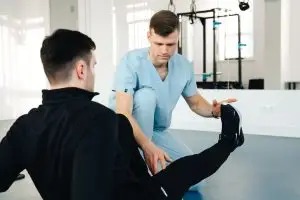
When your knee hurts, it makes sense to blame the knee. But sometimes the real problem sits a little higher up, in your hips. Weak glutes are a common, and often missed, piece of the knee pain puzzle.
What’s going on: the hip and knee connection
Knee pain is one of the most common complaints in active people at every level. Some knee problems come straight from an injury to a ligament or tendon. But many people don’t realize how much the hip muscles affect the forces at the knee.
Your glutes are a group of three muscles: gluteus maximus, gluteus medius and gluteus minimus. They control hip extension (driving your leg back) and help control rotation and side-to-side motion of your thigh bone.
When the glutes are weak, or when other muscles like the hamstrings and the TFL and IT band take over, your pelvis gets less stable. Then your knee can cave inward or twist as you walk, run, squat or land. That puts stress on the knee that it isn’t built to handle.
What the research says
Researchers now look at the whole chain of the hip, knee and ankle when studying leg injuries. A 2007 study by Rowe and colleagues in the North American Journal of Sports Physical Therapy looked at active women with knee pain on one side. They found glute strength was significantly lower on the painful leg compared with the other leg.
That’s a good reason to take a closer look at the hips whenever knee pain shows up.
Signs your glutes may be part of the problem
- Your knee drifts inward when you squat, step down or land from a jump
- Your hip drops on one side when you stand on one leg
- Knee pain that gets worse with stairs, running or long walks
- Tightness along the outside of your thigh
These clues don’t prove the cause on their own. A physical therapist can evaluate your strength and movement to find out what’s really going on.
Exercises that target the glutes
These moves have been shown to work the glute muscles. Start easy, focus on good form, and stop if your knee pain gets worse.
- Bridges: lie on your back with knees bent. Tighten your belly and squeeze your glutes as you slowly lift your hips, keeping your pelvis level, then lower back down. To progress, try it on one leg.
- Clamshells: lie on your side with hips bent about 45 degrees and heels in line with your rear. Keep your heels together and slowly open your top knee without rolling your pelvis back. A resistance band around the knees makes it harder.
- Side plank: prop yourself up on your elbow and forearm and lift your hips so your body forms a straight line. To progress, slowly raise and lower your top leg while you hold.
- Side stepping: keep your core tight, toes straight ahead and knees slightly bent, then take small steps to the side. Add a band at the ankles or toes for more challenge.
- Squats: feet shoulder-width apart, core tight, chest up. Lower slowly, keeping your knees lined up over your second toe. To progress, try a single-leg squat without letting the knee fall inward.
How physical therapy helps
Generic exercises are a good start, but knee pain has many possible causes. At ProActive Physical Therapy, a Doctors of Physical Therapy company, your therapist checks your hip, knee and ankle strength, watches how you move, and builds a plan around what they find.
Care may include strength work that builds over time, movement training for running, jumping and lifting, and hands-on treatment as needed. Learn more about our physical therapy services.
Your simple plan
- Book an evaluation at one of our six San Diego County clinics in Carlsbad, Carmel Valley, Mission Valley, National City, Rancho Bernardo or Vista.
- Evaluate: your therapist tests your strength and watches how you squat, step and land.
- Treat: you get focused care and a home program that targets your weak links.
- Return: you work back into running, sports and daily activity with better control.
When to see a doctor
See a doctor if your knee swells up right after an injury, locks or gives way, looks deformed, or can’t hold your weight. Redness, warmth and fever with knee pain also need a doctor’s attention.
FAQs
Can weak glutes really cause knee pain?
They can be part of it. Weak glutes can let your knee move in ways that add stress. A physical therapist can evaluate whether that’s happening in your case.
Which glute muscle matters most for the knee?
The gluteus medius gets a lot of attention because it helps keep your pelvis level and your knee from caving in. All three glute muscles work together, though.
Should I stop running if my knee hurts?
Not always. Your therapist can help you adjust how much and how hard you run while you build strength.
Do I need equipment for these exercises?
No. Most can be done with just your body weight, and a resistance band adds a challenge later on.
California allows direct access to physical therapy, so no referral is needed to start. If knee pain is holding you back, book an evaluation and let’s check your hips too.
Ready to get started? Schedule an appointment at any ProActive clinic or find a Doctors of Physical Therapy clinic near you. No referral needed.