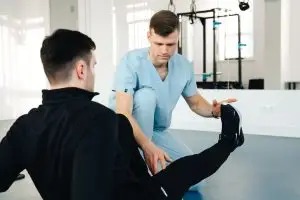
Nobody plans to fall. It happens in a split second on a trail, a court or your own kitchen floor. Learning how to fall safely ahead of time can help you avoid some painful, sometimes serious injuries.
Why the way you fall matters
Many fall injuries come from how we land, not just the fall itself. The natural reflex is to stiffen up and throw a hand out. That puts a lot of force through the wrist, elbow and shoulder all at once.
The good news is that a few simple habits can spread that force out. Athletes in martial arts, gymnastics and parkour practice falling on purpose for exactly this reason.
General tips to fall more safely
- Get low. If you feel yourself losing your balance, crouch down so you don’t have as far to fall.
- Don’t catch yourself with your hands. Try to land on the fleshy, padded parts of your body and roll.
- Stay loose. Relaxing your body, rather than stiffening up, helps absorb the impact.
- Protect your head. Tuck your chin and turn your head to the side.
- Turn to the side. In mid-fall, twist or roll so you land on your side and backside, which have more padding than your back.
- Spread the impact. Keep your wrists straight and your elbows and knees bent and close to your body. Land with as much of your trunk as you can.
A beginner roll from parkour
Parkour can be a risky sport, but the way it teaches falling is useful for any sport, age or lifestyle. One technique comes from the martial arts idea of ukemi, a Japanese term often described as the art of falling.
A basic beginner roll, sometimes called the triangle to back roll, is a gentler version of a gymnast’s roll. It’s designed to protect the neck, spine, shoulder and wrist.
The key points of the roll
- Relax. It sounds hard to do, but stiffening up raises your chance of getting hurt.
- Tuck. Tuck your chin and look toward your stomach.
- Reach to the side. Instead of reaching straight ahead, reach out in front and slightly toward the side you plan to roll to.
- Make a triangle. Put your palms flat with your thumbs and pointer fingers touching to form a triangle. This bends your elbows so your arms absorb the impact.
- Tuck the shoulder in. Turn your lead shoulder inward so you don’t land directly on the top of it, where the collarbone and shoulder are easy to injure.
- Roll on a diagonal. Roll from your shoulder across your back to the opposite hip, rather than straight down your spine.
- Practice both sides. Real falls don’t let you choose your favorite side.
Practice on a soft surface like a mat or grass, and learn it from a qualified coach or instructor if you can. Skip practicing rolls if you have neck, back or shoulder problems, or any health condition that makes falling risky, until you’ve talked with your doctor or physical therapist.
Can practice really help?
Most of the time, there’s no time to think during a fall. But habits you’ve practiced can kick in on their own. Even one tip, like getting low when you feel yourself going down, can make a difference in how you land.
Lowering your risk of falling in the first place
Strength, balance and reaction time all affect how likely you are to fall. A physical therapist can test your balance and build a program to improve it. Some clinics use tools like the Biodex Balance System to measure balance and track progress.
A simple plan
At ProActive Physical Therapy, a Doctors of Physical Therapy company, our six San Diego County clinics (Carlsbad, Carmel Valley, Mission Valley, National City, Rancho Bernardo and Vista) help people of all ages move with more confidence:
- Book. Schedule a balance or injury evaluation. No referral is needed in California.
- Evaluate. A physical therapist can evaluate your strength, balance and any past injuries.
- Treat. You get a plan for strength, balance and safe movement for your sport or daily life.
- Return. Get back to the activities you love with better control.
When to see a doctor
Get medical care after a fall if you hit your head, feel confused or dizzy, can’t put weight on a limb, see a deformity, or have pain or swelling that doesn’t settle. If you’ve fallen more than once recently, talk with your doctor about why.
FAQs
Is it really bad to catch myself with my hands?
It’s a natural reflex, but landing on an outstretched hand is a common cause of wrist, elbow and shoulder injuries. Spreading the impact across your body is usually safer.
Can older adults learn to fall safely?
Yes, though the focus is usually on preventing falls through strength and balance training. A physical therapist can help you decide what’s safe to practice.
What sports teach safe falling?
Martial arts, judo, gymnastics and parkour all teach falling techniques. Many other sports coaches cover it too.
Ready to get started? Schedule an appointment at any ProActive clinic or find a Doctors of Physical Therapy clinic near you. No referral needed.