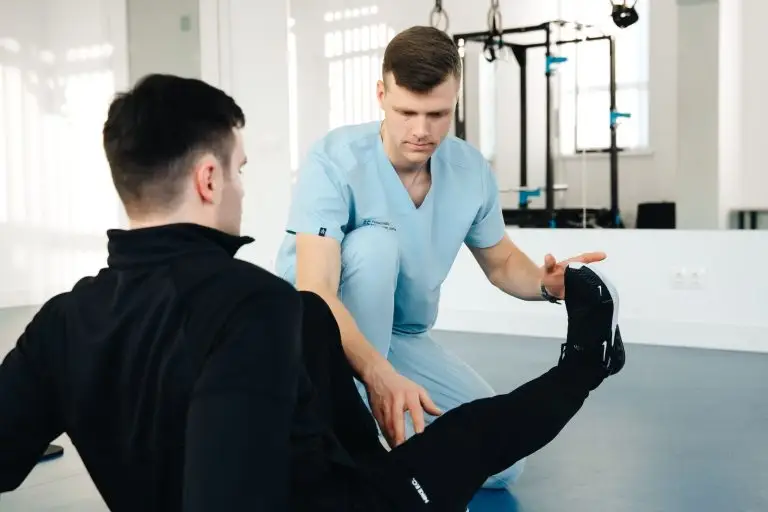
A herniated disc doesn’t have to mean surgery. In fact, for the majority of people, herniated disc physical therapy is the most effective first-line treatment, and one of the most researched approaches in musculoskeletal medicine. If you’re dealing with shooting pain, numbness, or weakness in your back, neck, or limbs, a licensed physical therapist can help you understand exactly what’s happening and start fixing it.
At Doctors of Physical Therapy, every patient is treated by a licensed physical therapist, not a tech, not an aide, not an assistant. That’s not common. It’s our standard.
What Is a Herniated Disc?
Your spine is made up of vertebrae separated by cushioning discs. Each disc has a tough outer layer (the annulus fibrosus) and a soft, gel-like center (the nucleus pulposus). When the outer layer weakens or tears, the inner material can push outward and press on nearby nerves.
This pressure causes the symptoms most people associate with disc problems: radiating pain down the arm or leg, numbness or tingling, muscle weakness, or sharp pain with certain movements. The cervical spine (neck) and lumbar spine (lower back) are the most commonly affected areas.
The good news: research consistently shows that herniated disc physical therapy produces significant improvement, and that the vast majority of herniated discs improve without surgery. A landmark study in The Spine Journal found that up to 90% of patients with lumbar disc herniation reported meaningful pain reduction with conservative treatment within three months.
5 Proven Herniated Disc Physical Therapy Treatments
1. Directional Preference Exercises (McKenzie Method)
Not all movement is equal for a herniated disc. The McKenzie Method, one of the most evidence-based approaches in herniated disc physical therapy, identifies the specific direction of movement that reduces your pain and centralizes nerve symptoms. Your physical therapist performs a detailed movement assessment to find your “directional preference,” then builds a targeted exercise program around it.
For lumbar disc herniations, extension exercises (like press-ups) often centralize and reduce symptoms. For some patients, flexion-based movements work better. The key is that this approach is individualized, there’s no one-size-fits-all program.
2. Manual Therapy
Hands-on treatment is a core part of herniated disc physical therapy. Manual therapy at DPT includes joint mobilization, soft tissue work, and neural mobilization, techniques that restore movement in the spine, reduce muscle guarding, and decrease nerve tension.
A 2021 systematic review published in the Journal of Orthopaedic & Sports Physical Therapy (JOSPT) found that combining manual therapy with exercise produced better outcomes for lumbar disc herniation than either approach alone. Your physical therapist will use clinical judgment to select the most appropriate techniques based on your presentation.
3. Therapeutic Exercise and Core Stabilization
Once acute pain is managed, rebuilding strength is essential. Weakness in the deep spinal stabilizers, the muscles that support each vertebral segment, is a major factor in disc problems recurring. Your physical therapist will guide you through progressive strengthening exercises targeting the transverse abdominis, multifidus, and surrounding hip and gluteal muscles.
This isn’t generic “core work.” It’s precise, progressive, and monitored. The goal is to build the muscular support your spine needs so the disc isn’t carrying load it shouldn’t be.
4. Traction and Decompression
Mechanical traction creates a gentle separation of the vertebral segments, reducing pressure on the disc and nearby nerve roots. It’s one of the more specialized tools in herniated disc physical therapy, and it’s most effective for patients with clear nerve root compression signs.
Research published in Physical Therapy, the official journal of the APTA, supports lumbar traction as a component of a broader treatment plan for disc-related nerve pain. Your physical therapist will determine if traction is appropriate for your specific presentation and use it as part of a comprehensive approach, not as a standalone treatment.
5. Posture and Movement Retraining
How you sit, stand, lift, and move puts constant mechanical load on your discs. Poor posture, especially prolonged forward head position or lumbar flexion, is one of the primary drivers of disc problems in the first place. A key part of herniated disc physical therapy is identifying the movement habits that stress your spine and replacing them with safer, more efficient patterns.
This includes ergonomic education, body mechanics training for lifting, and building awareness of positions that aggravate versus relieve your symptoms. These changes reduce load on the disc between visits, and long after discharge.
When to Start Herniated Disc Physical Therapy
The earlier you start, the better. Early physical therapy intervention has been shown to reduce the risk of needing more aggressive treatment down the road. And in Illinois, you don’t need a referral to see a physical therapist. You can schedule directly.
If you’re experiencing back or neck pain with arm or leg symptoms, don’t wait on a doctor’s appointment to get cleared. Book an appointment at DPT and get a full evaluation from a licensed physical therapist who can tell you exactly what’s happening and what will help.
What to Expect at Your First Visit
Your first appointment at DPT is a comprehensive evaluation. Your physical therapist will assess your posture, range of motion, neurological signs, strength, and movement quality. They’ll review any imaging you have, but they’ll also evaluate you as a person, not just a picture of your spine.
From there, you’ll get a clear explanation of your diagnosis, a realistic picture of what recovery looks like, and a specific plan tailored to you. At DPT, the organization is clinician-led from top to bottom, every clinical director is a licensed physical therapist. That means every decision about your care is made by someone with deep clinical expertise, not an administrator. Learn more about our approach here.
Have insurance questions? See how insurance and direct-pay options work at DPT.
The Research Is Clear
The American Physical Therapy Association (APTA) recommends physical therapy as the primary conservative treatment for lumbar and cervical disc herniation. A 2020 study in JAMA confirmed that early physical therapy for spine conditions significantly reduces downstream healthcare costs, including imaging, injections, and surgery.
You don’t have to live with disc pain. You don’t need a referral to get started. Herniated disc physical therapy is one of the most effective treatments available, and DPT’s licensed physical therapists are ready to help you get moving again.
Frequently Asked Questions
Can herniated disc physical therapy actually heal the disc?
Physical therapy won’t “fill in” a herniated disc, but it doesn’t need to. Research shows that the body naturally reabsorbs herniated disc material over time, and physical therapy accelerates symptom relief by reducing nerve irritation, improving spinal mechanics, and building the strength that protects the disc. Most people experience significant improvement well before full reabsorption occurs.
How long does herniated disc physical therapy take?
Every case is different. Mild to moderate herniations typically respond well within several weeks of consistent treatment. More severe nerve compression or long-standing cases may take longer. Your physical therapist will give you a realistic, individualized timeline at your first evaluation.
Do I need a referral to start herniated disc physical therapy?
No. In Illinois and most states, you can see a licensed physical therapist directly, no referral required. This is called direct access. You can schedule an appointment at DPT today without waiting on a physician’s order.
What’s the difference between herniated disc physical therapy and seeing a chiropractor?
Physical therapists focus on treating the underlying cause through movement rehabilitation, strength building, manual therapy, and neuromuscular retraining. The goal is full, lasting recovery, not symptom management. Physical therapists also have advanced training in differential diagnosis, so they can screen for red flags and coordinate with your physician if imaging or referral is needed.